
Battery pack
When does a pack in a sealed box pass 60 C?
You ask
Will this battery pack overheat in a sealed box during a one hour discharge?
Wobbl runs
$ wobbl simulate pack.py "Will this battery pack overheat in a sealed box during a one hour discharge?" \ --physics heat -m li-ion-cell --power "6 W" --film "5 W/m2K @ all" \ --ambient "35 C" --radiation 0.9 --duration "60 min" --limit "60 C"
Time 60:00 of 60:00400× speed, lines every 0.5 C
74.5 C
HOT
Passes 60 C at 21:04
Checks, numbers and charts
HOTHottest point reaches 74.5 C (limit 60 C) at (18.5, 18.5, 31.8) mm after 60 min. It passes 60 C after about 21.1 min.
- Max temperature
- 74.5 C
- Limit
- 60 C
- Power
- 6 W
- Confidence
- high
- passmesh convergence
- passenergy balance
- passhand calculation
- passunits and sanity
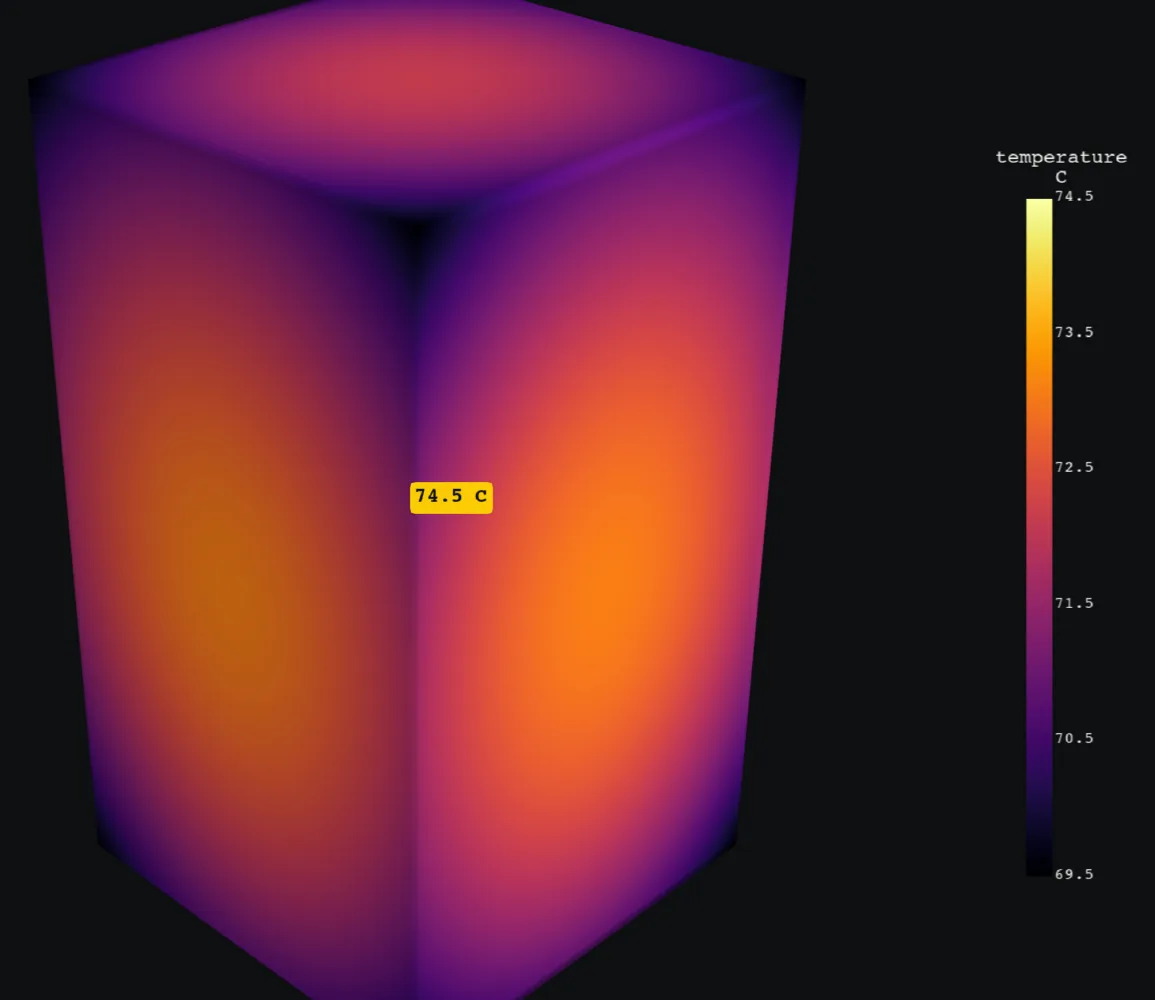
HOT. Hottest point reaches 74.5 C (limit 60 C) at (18.5, 18.5, 31.8) mm after 60 min. It passes 60 C after about 21.1 min. Confidence: high. passed mesh convergence, energy balance, hand calculation, units and sanitymax temperature: 74.5 Climit: 60 Cpower: 6 Wmesh nodes: 9,610 Checks: [pass] mesh convergence: temperature rise at the hottest point settled: 39.5 -> 39.5 C over 2 meshes, last change 0.0% [pass] energy balance: over 60 min, heat in 21.6 kJ, stored 7.98 kJ, out through the surfaces 13.4 kJ (1% apart) [pass] hand calculation: lumped model with convection and radiation (Biot 0.012) gives a mean of 72.2 C at the end; FEA mean is 72.8 C (1.6% of the rise) [pass] units and sanity: temperatures between 69.5 and 74.5 C Assumptions: - Li-ion cell (lumped, effective): conductivity 3 W/(m K), specific heat 950 J/(kg K), density 2500 kg/m3. - Heat is generated evenly through the part. - Convection uses a fixed film coefficient; real coefficients vary with temperature and airflow. - Surrounding air or coolant at 35 C does not heat up. - Radiation with emissivity 0.9. - Contact resistance between parts and internal airflow are not modeled. Suggested fixes: - Raise heat transfer about 2x: The temperature rise scales with 1/(h A). A small fan takes h from about 5 to 25 W/(m2 K); fins or a larger case add area. Either way you need about 2x the current 5 W/(m2 K) times area. - Cut the power to 3.04 W: Lower current or duty cycle; the rise is proportional to the heat made. Images: temperature: images/temperature.png, history: images/history.pngReport: report.htmlAbout this example
This 2S2P pack of 18650 cells is treated as one 37 x 37 x 65 mm block with effective cell properties, and it makes 6 W during a one hour discharge inside a sealed plastic box at 35 C. Still air gives about 5 W/(m2 K), and the wrap radiates with an emissivity of 0.9.
| Result | Value |
|---|---|
| Hottest point after 60 min | 74.5 C, over the 60 C limit for Li-ion cells |
| Time to pass 60 C | about 21 minutes |
| Hand calculation | a lumped model with convection and radiation gives a mean of 72.2 C at 60 min, and the FEA mean is 72.8 C |
Temperature over the discharge
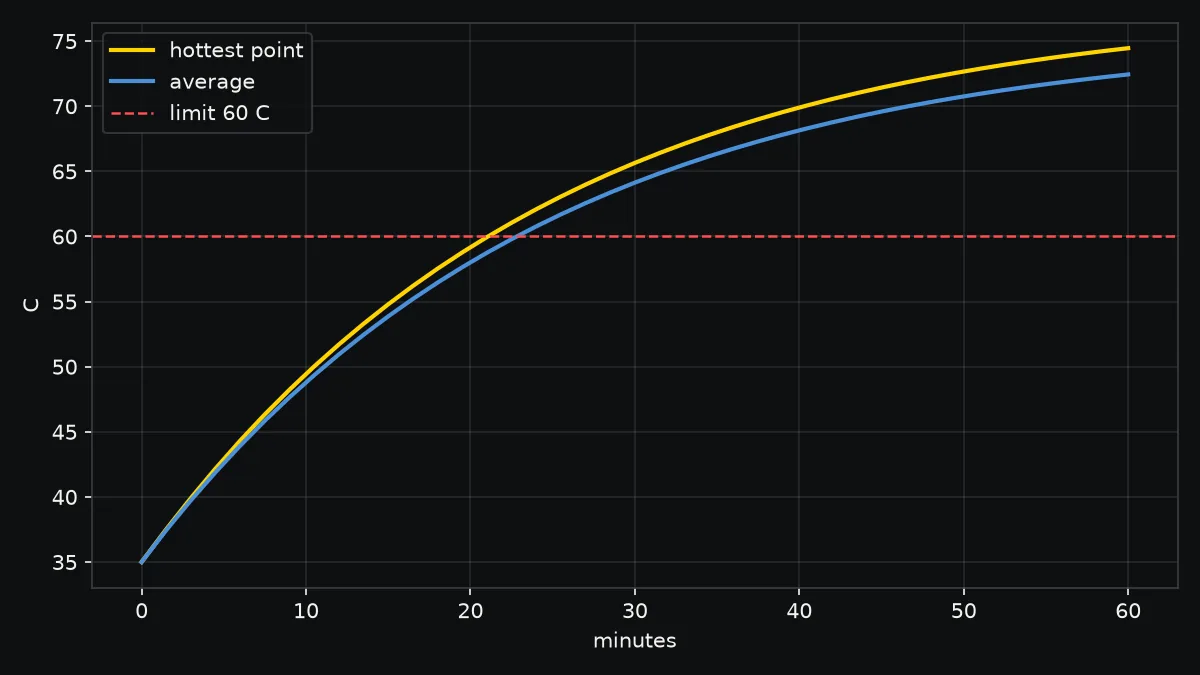
The pack heats almost uniformly (Biot number 0.012), so the answer is set by how fast the box sheds heat. Wobbl suggests roughly doubling the heat transfer, with airflow or a thermal path to a metal wall, or cutting the heat to about 3 W, which keeps the pack near 55 C with some margin under the limit.
Run it yourself
$ git clone https://github.com/sohan-bhat/wobbl$ cd wobbl/examples/battery-pack && ./run.shThe part, the script and every output are in examples/battery-pack on GitHub.