
Cell runaway
Can a cell at the hottest point of the sealed battery pack run away on its own?
You ask
Can a cell at the hottest point of the sealed battery pack run away on its own?
Wobbl runs
$ wobbl simulate "lithium ion 18650 cell" "Can a cell at the hottest point of the sealed battery pack run away on its own?" \ --physics runaway --film "sealed box" --from ../battery-pack/output
Oven 74.46 C of 74.46 C
peak self heating
0.0220 C/min
OK
Peak cell temperature 74.69 C, above the oven 0.230 K
Passes the 10 C/min limit at 155 C
Checks, numbers and charts
OKThermal runaway starts above 155 C, 80.4 K above the 74.5 C the 18650 cell sits in, so self heating cannot run away.
- Runaway above
- 155 C
- Surroundings
- 74.5 C
- Margin
- 80.4 K
- Confidence
- high
- passlumped cell
- passenergy balance
- passtime step convergence
- infoclosed form
- passSemenov bound
OK. Thermal runaway starts above 155 C, 80.4 K above the 74.5 C the 18650 cell sits in, so self heating cannot run away. Confidence: high. passed lumped cell, energy balance, time step convergence, Semenov boundrunaway above: 155 Csurroundings: 74.5 Cmargin: 80.4 KSemenov estimate: 107 C Checks: [pass] lumped cell: Biot number 0.00581 for 5 W/(m2 K) over the cell, so its inside stays within 0.291% of one temperature [pass] energy balance: heat made equals heat stored plus heat shed to 9.4e-14% over each transient [pass] time step convergence: at 155 C the cell runs away after 68.6 min, and 68.6 min with a tolerance 100 times tighter (7.7e-05% apart) [info] closed form: at the Semenov point the cell sits 11.4 K above its surroundings, against R Ta^2 / E = 8.92 K for one reaction carrying 67% of the heat, 27% apart [pass] Semenov bound: with fresh reactants that never run out the cell would run away above 107 C, below the 155 C the transient needs, since the small store of SEI burns out before it can carry the cell Assumptions: - LiCoO2 cell at 100% charge (Moli ICR18650), 18 by 65 mm, with the kinetics of Hu, He, Rein and Restuccia, Numerical Study of Self-Heating Ignition of a Box of Lithium-Ion Batteries During Storage, Fire Technology 2020, Table 2, from Hatchard et al. 2001 and Kim et al. 2007. - Cooled by 5 W/(m2 K) of convection and radiation at an emissivity of 0.8 over its whole surface, in surroundings taken from the hottest point of the heat study in ../battery-pack/output. - The cell is lumped, open circuit and at rest, with no internal short, overcharge or outside fire. Runaway is the moment the cell heats itself faster than 10 C/min, the trigger Feng et al. (Frontiers in Energy Research 2018) use. - The kinetics describe a fully charged LiCoO2 cell. LFP cells run away at higher temperatures and NMC cells at similar ones, so for other chemistries treat the answer as indicative. - The kinetics carry the cell up to the trigger. What follows it, the separator melting, venting and fire, is beyond them, so the temperatures after the trigger are not a forecast. Images: onset: images/onset.pngReport: report.htmlAbout this example
The battery pack example finds its hottest point reaching 74.5 C during a one hour discharge in a sealed box. This run takes that temperature straight from the pack’s result as the surroundings of one charged 18650, cooled by the still air of a sealed box at 5 W/(m2 K), and asks at what surrounding temperature the cell’s own decomposition would outrun its cooling.
| Result | Value |
|---|---|
| Thermal runaway onset | 155 C, the lowest surrounding temperature at which the cell heats itself faster than 10 C/min |
| Surroundings | 74.5 C, from the pack’s heat study |
| Margin | 80.4 K |
| Semenov estimate | 107 C with fresh reactants that never run out, the classical bound |
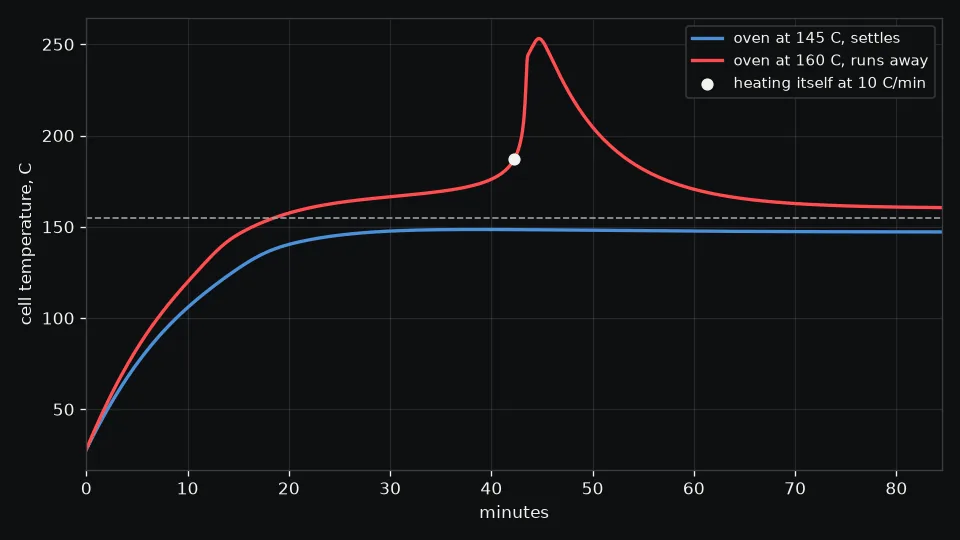
Cell temperature in ovens just under and just over the onset
Self heating cannot run away at the pack’s temperature, so the risk in this pack is the 60 C
service limit the heat study already flags, not runaway. The onset comes from Hatchard’s kinetics
for a fully charged LiCoO2 cell, and in Wobbl’s validation the same model lands within a kelvin of
the 155 C that Hu, He, Rein and Restuccia’s model and Hatchard’s oven tests give for a cell cooled
at 7.17 W/(m2 K). The Semenov bound sits lower because the
cell’s small store of SEI burns out before it can carry the cell on its own. Other chemistries run
away at other temperatures, so for them the answer is indicative, and what happens after the
trigger, venting and fire, is beyond these kinetics. The output folder also holds playback.json,
the two oven runs frame by frame with how much of each reactant is left.
Run it yourself
$ git clone https://github.com/sohan-bhat/wobbl$ cd wobbl/examples/cell-runaway && ./run.shThe part, the script and every output are in examples/cell-runaway on GitHub.