
Enclosure
Does a polycarbonate shell survive a thumb press, and how far does it dent?
You ask
Does the PC shell survive a 120 N thumb press, and how far does the top dent?
Wobbl runs
$ wobbl simulate enclosure.py "Does the PC shell survive a 120 N thumb press, and how far does the top dent?" \ --physics stress -m pc --fix "z=min" \ --load "120 N down @ top and within 8 of 25,15,28" --budget 600
Load 120 N of 120 N
8.77 MPa
HOLDS
Checks, numbers and charts
HOLDSPeak 9.77 MPa in the wall under face 2 at (23.9, 12, 26.5), safety factor 6.34 against yield (target 2). Confidence is medium.
- Peak stress
- 9.77 MPa
- Safety factor
- 6.34
- Target
- 2
- Confidence
- medium
- passmesh convergence
- passforce balance
- infosingularities
- passshell model
- warnsolid cross check
- passunits and sanity
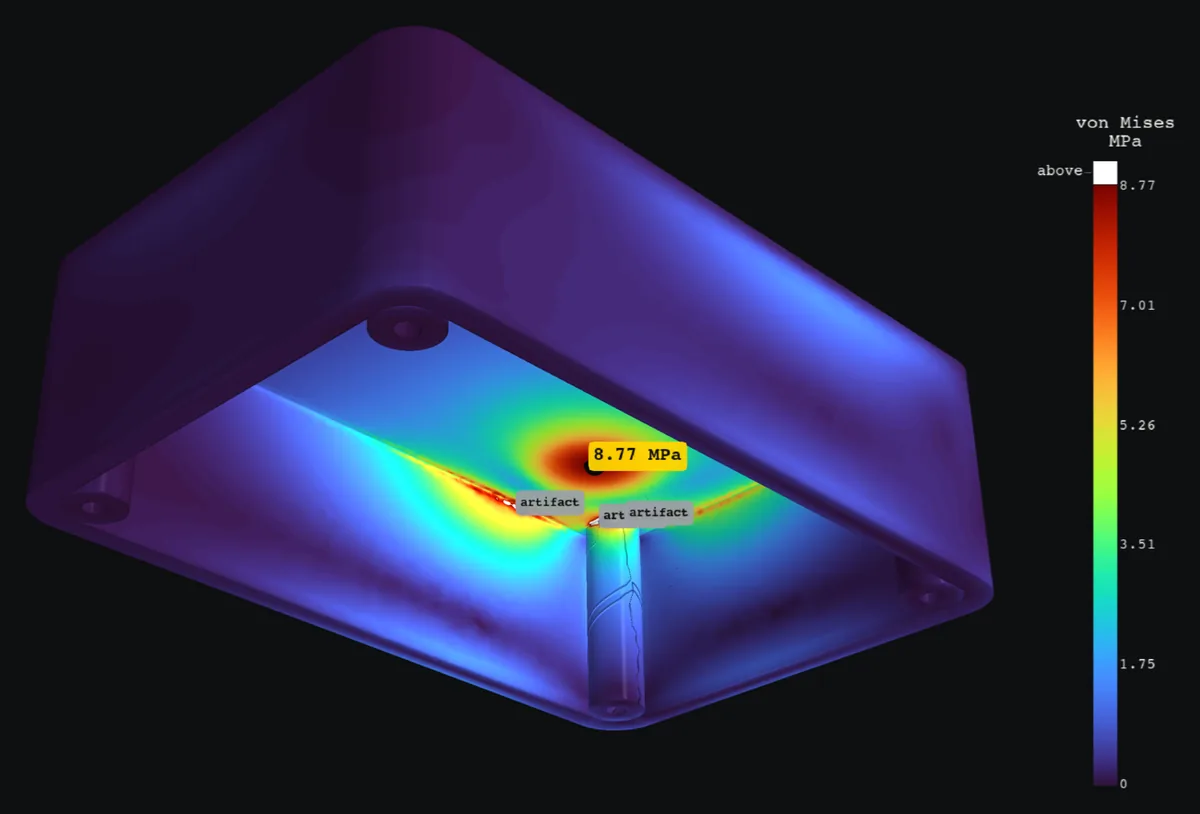
HOLDS. Peak 9.77 MPa in the wall under face 2 at (23.9, 12, 26.5), safety factor 6.34 against yield (target 2). Confidence is medium. Confidence: medium. solid cross check: a coarse solid (21,774 nodes) gives 0.208 mm of deflection against the shell's 0.222 mm (+6%), and 8.32 MPa within 6 mm of the shell's governing point against 9.7 MPa (+17%), both on first meshes. The shell idealization moves the answer that much here, so read the shell numbers with that marginMax deflection 0.23 mm at (22.1, 9.39, 26.5).Material Polycarbonate, limit 62 MPa; mass 48.78 g.Loads: 120 N down @ top and within 8 of 25,15,28. Fixtures: fixed z=min. Checks: [pass] mesh convergence: von Mises stress settled: 9.7 -> 9.53 -> 9.77 MPa over 3 meshes, last change 2.5% [pass] force balance: reactions balance the loads to 3.6e-10% (forces; shell supports also hold rotations, whose reaction moments are not compared) [skip] hand calculation: no simple beam model applies (the part is not slender) [info] singularities: excluded from the answer: 10.4 MPa at (34.5, 22.2, 26.5), within 3 mm of a support, boss joint or rigid attachment, where the idealization sets the stress. Wobbl reports the stress away from these spots [pass] shell model: the shell holds 92% of the part's material and 4 bosses as beams bring it to 100%; 17 rim or edge faces are not walls [warn] solid cross check: a coarse solid (21,774 nodes) gives 0.208 mm of deflection against the shell's 0.222 mm (+6%), and 8.32 MPa within 6 mm of the shell's governing point against 9.7 MPa (+17%), both on first meshes. The shell idealization moves the answer that much here, so read the shell numbers with that margin [pass] units and sanity: part 112 mm across, peak strain 0.0042, max deflection 0.23 mm (0.21% of size): all plausible Assumptions: - Linear elastic material and small deflections (no yielding redistribution, no buckling). - Polycarbonate: E 2350 MPa, Poisson 0.37, von Mises vs yield 62 MPa (Covestro Makrolon 2405 datasheet). - Loads are static and applied all at once; no impact, vibration or fatigue. - Walls are shells on their midsurface with the thickness the CAD gives at each point; stress is taken on both faces. Through the thickness stress under a load and at sharp inside corners is not modeled. - Fixed faces hold the walls they touch against moving and turning. - 4 bosses are beams with their own round or pipe section, joined to the wall they meet by a stiff spider over their outline; their own weight is left out. - Rims, edges and chunky features that are not walls are left out of the shell, so their stiffness and stress are not in the model; the solid cross check shows what that costs. - Molded part treated as isotropic and uniform; weld lines and the area near the gate can be weaker than the datasheet. - Points within 3 mm of supports, boss joints and rigid attachments are left out of the answer. Images: stress: images/stress.png, safety: images/safety.png, deformed: images/deformed.png, convergence: images/convergence.pngReport: report.htmlAbout this example
This is the top shell of a handheld device, 90 x 60 x 28 mm with 3 mm walls and four screw bosses, held at its rim. A thumb presses 120 N on a 16 mm patch near one corner.
| Result | Value |
|---|---|
| Peak stress | 9.77 MPa in the top wall under the press, safety factor 6.3 against PC’s 62 MPa yield |
| Dent under the thumb | 0.23 mm |
| Mesh convergence | 9.70, 9.53, 9.77 MPa over three meshes |
| Equilibrium | reactions balance the 120 N to 4e-10% |
Wobbl solves the walls as shells, with the four bosses as beams, which carries all of the part’s material. A coarse solid model run beside it gives 0.208 mm of dent and 8.3 MPa near the same spot, 6% and 17% from the shell, so confidence is medium and the numbers carry that margin. The shell holds this press with a wide margin either way.
The study takes about a minute and a half on a 2018 six core laptop.
Run it yourself
$ git clone https://github.com/sohan-bhat/wobbl$ cd wobbl/examples/enclosure && ./run.shThe part, the script and every output are in examples/enclosure on GitHub.