
Motor mount fatigue
Does the cast motor mount last ten years of starts and running without a fatigue crack?
You ask
Does the cast motor mount last ten years of starts and running without a fatigue crack?
Wobbl runs
$ wobbl simulate ../cast-motor-mount/output "Does the cast motor mount last ten years of starts and running without a fatigue crack?" \ --physics fatigue --block "100% x 3650 R=0" \ --block "70% x 1e8 R=0.714" --repeats 10
Duty load 100 % of 100 %
peak share of fatigue strength
0.889
MARGINAL
Damage 0.627, safety factor 1.03
Passes the 1 limit at 112 %
Checks, numbers and charts
MARGINAL10 runs of the duty cycle use 62.7% of the fatigue life on the 3.99 mm inside fillet (face 65) at (43.9, 8.96, 79.6) (Miner's rule), so it can run about 16 times before cracks start, and the stresses could rise 1.03 times before the required 10 runs would start a crack (target 2). Confidence is medium.
- Life
- 16 repeats
- Safety factor
- 1.03
- Required
- 10 repeats
- Confidence
- medium
- warnstrength result
- passfirst cycle yield
- infoS-N range
- passmean stress model
- passother peaks
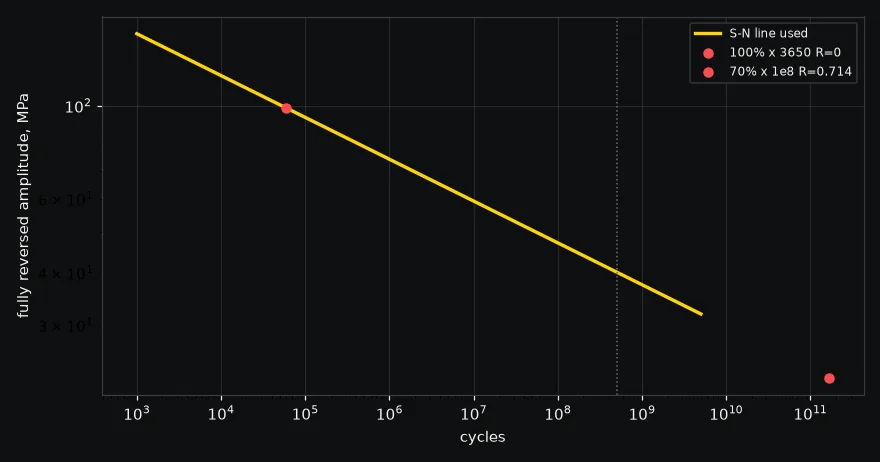
MARGINAL. 10 runs of the duty cycle use 62.7% of the fatigue life on the 3.99 mm inside fillet (face 65) at (43.9, 8.96, 79.6) (Miner's rule), so it can run about 16 times before cracks start, and the stresses could rise 1.03 times before the required 10 runs would start a crack (target 2). Confidence is medium. Confidence: medium. strength result: the stresses come from a result Wobbl rated medium confidence (load introduction: the off part loads enter through a distributing coupling (the attached part adds no stiffness)); the S-N line comes from a rule of thumb for this material, not a fatigue testlife: 16 repeatssafety factor: 1.03required: 10 repeatstarget: 2 Checks: [warn] strength result: the stresses come from a result Wobbl rated medium confidence (load introduction: the off part loads enter through a distributing coupling (the attached part adds no stiffness)) [pass] first cycle yield: the highest stress in a cycle, 124 MPa, stays under the 165 MPa yield (factor 1.21), so the part stays elastic and the stress life method applies [info] S-N range: a block lasts 1.66e11 cycles, past the 500 million the data reach, so that life extends the line [pass] mean stress model: the mean stress models give safety factors of Goodman 1.03, Gerber 1.29 and Soderberg 1.03. The answer uses Goodman, and the verdict is the same with each [pass] other peaks: 2 stress peaks were tracked away from supports and sharp corners, and under the same cycling none starts a crack sooner than the one judged Assumptions: - Wobbl guessed: required life not given, so Wobbl assumed 1e7. - Stress life method for crack initiation, as Shigley sets it out, with an S-N line from f Sut at 1000 cycles to the corrected endurance strength. It does not cover crack growth after a crack starts, which is a separate damage tolerance question. - S-N data for Custom material (cast) give 42.7 MPa at 500 million cycles, smooth specimens, fully reversed (estimated as 0.26 Sut at 5e8 cycles, the ratio of sand cast A356-T6). - The Marin factors are surface as-cast (1.00), size 1.05, load 1.00, reliability 90% (0.897), with the part at room temperature. - Mean stress by Goodman, with no credit for a compressive mean. - Fatigue lives scatter by a factor of three to ten at the same stress, so the life is an estimate and the safety factor on stress is the steadier number. - Each block scales the studied load and cycles it between R times its peak and the peak (or at the study's load ratio when the block gives none), and the stress field keeps its shape, as it does for a linear part. Suggested fixes: - Cut the cyclic stress by 49%: A safety factor of 2 needs every stress 1.94 times lower. In bending the stress falls with the square of the wall, so about 1.39 times the thickness at the peak gets there. - Switch to Aluminum 6061-T6: Its fatigue strength is 2.3 times that of Custom material (cast), which covers the 1.94 needed if the part is otherwise the same. It is a wrought alloy, so the part would be made that way instead. Images: sn: images/sn.png, haigh: images/haigh.pngReport: report.htmlAbout this example
This reads the finished strength result of the cast-motor-mount example, a sand cast aluminum mount whose peak of 124 MPa under the 2 kN belt pull sits on the 4 mm inside fillet at the rib tip. A static safety factor of 1.33 says nothing about how often that load comes and goes, so this run gives it a duty cycle for each year of service.
- 3650 starts, ten a day, each taking the belt pull from nothing to the full 2 kN and back.
- 100 million turns of running, each swinging the pull between 50% and 70% of 2 kN.
| Result | Value |
|---|---|
| Verdict | MARGINAL, a factor of 1.03 on stress against the target of 2 for a casting |
| Damage over ten years | 62.7% of the fatigue life by Miner’s rule, about 16 years before a crack starts |
| Starts | 62 MPa either side of 62 MPa, a life of 58,800 cycles, almost all of the damage |
| Running | 12 MPa either side of 74 MPa, a life of 1.7e11 cycles, 0.06% of the life each year |
| S-N line | 42.7 MPa at 500 million cycles for this casting, estimated from sand cast A356-T6 |
| Mean stress | Goodman 1.03, Gerber 1.29 and Soderberg 1.03, so the verdict does not hang on the choice |
| Static check | the highest stress in a cycle stays under yield, so the stress life method applies |
The running vibration barely counts, because its swing sits far down the S-N line. The starts do the damage, each one a full cycle from zero to 124 MPa at the fillet. The mount should not crack in ten years, but a factor of 1.03 on stress leaves no room for porosity near the fillet, and fatigue lives scatter by a factor of three to ten. Halving the stress at the fillet, with about 1.4 times the wall there, would meet the casting’s factor of 2. The strength result itself is medium confidence, because a rigid motor would carry the pull differently, and this answer inherits that.
The run also writes output/playback.json, with the damage building block by block over the ten years and
the damage at every scale of the duty’s loads. The report’s 3D view has a duty load slider, with the mount
colored by each spot’s share of its fatigue strength and the damage at the fillet read out.
Run it yourself
$ git clone https://github.com/sohan-bhat/wobbl$ cd wobbl/examples/motor-mount-fatigue && ./run.shThe part, the script and every output are in examples/motor-mount-fatigue on GitHub.