
Strut buckling
Does a slender aluminum strut carry 7 kN with a factor of 3 against buckling?
You ask
Does this aluminum strut carry 7 kN with a factor of 3 against buckling?
Wobbl runs
$ wobbl simulate strut.py "Does this aluminum strut carry 7 kN with a factor of 3 against buckling?" \ --physics buckling -m 6061-t6 --fix "z=min" --fix "fixed-xy z=max" \ --load "7 kN -z @ z=max" --target-sf 3
Load 7 kN of 7 kN
peak stress
51.4 MPa
MARGINAL
Factor against buckling 2.65, bow 0.866 mm
Passes the 137 MPa limit at 18.6 kN
Checks, numbers and charts
MARGINALBuckles at 3.25 times the applied load (22767 N) in a column mode. With a knockdown of 0.81 for imperfections and yielding the design factor is 2.64 against a target of 3.
- Buckling factor
- 3.25
- Knockdown
- 0.81
- Design factor
- 2.64
- Confidence
- high
- passmesh convergence
- passforce balance
- passhand calculation
- passmode separation
- passyield before buckling
- passunits and sanity
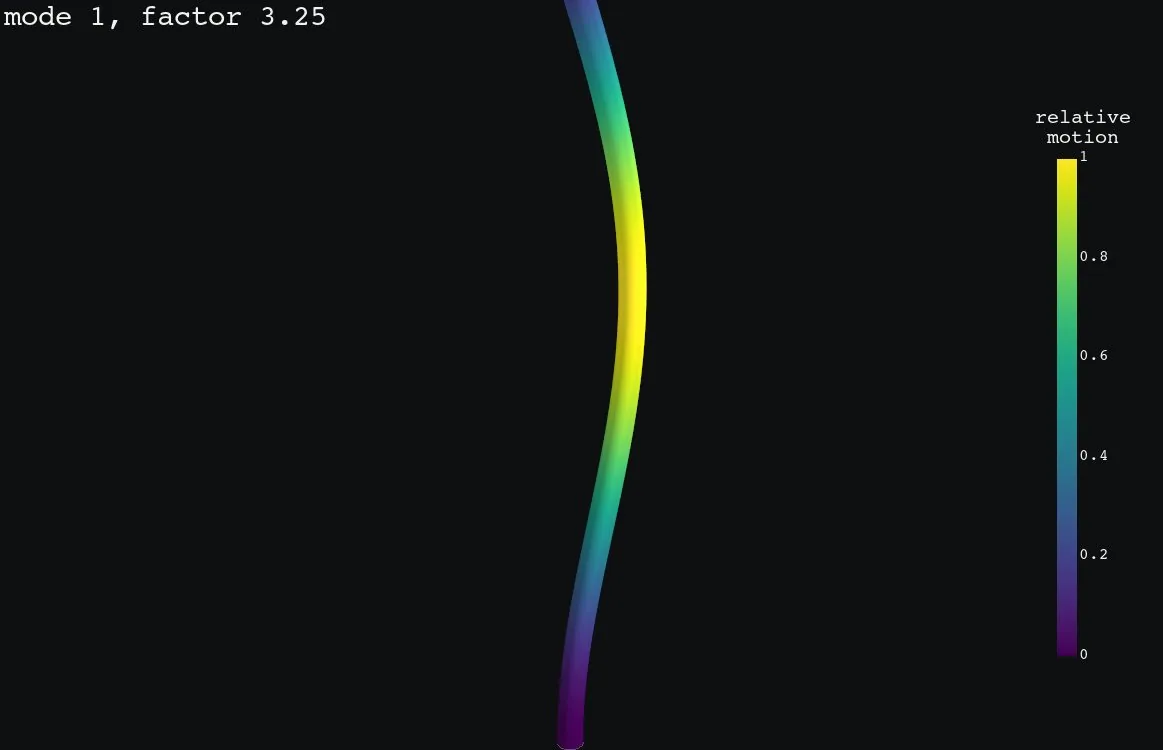
MARGINAL. Buckles at 3.25 times the applied load (22767 N) in a column mode. With a knockdown of 0.81 for imperfections and yielding the design factor is 2.64 against a target of 3. Confidence: high. passed mesh convergence, force balance, hand calculation, mode separation, yield before buckling, units and sanitybuckling factor: 3.25knockdown: 0.81design factor: 2.64target: 3 Checks: [pass] mesh convergence: first buckling factor settled: 3.25 -> 3.25 times the load over 2 meshes, last change 0.0% [pass] force balance: reactions balance the loads to 4.2e-05% (forces) and 3.7e-06% (moments) [pass] hand calculation: Euler's column, clamped at the base and pinned at the loaded end (K = 0.699), with I = 5838 mm4 over 600 mm gives 22570 N, a factor of 3.22, and the finite element factor is 3.25 (+0.9%) [pass] mode separation: the first factor repeats, the same buckle in two directions of a symmetric section, and the next distinct mode is at 9.42, 2.90 times the first [pass] yield before buckling: the most stressed point (50.9 MPa von Mises stress at the reference load, away from the supports) reaches 276 MPa at 5.42 times the load, after it buckles, so buckling governs [pass] units and sanity: buckling factor 3.25, deflection 0.381 mm under the reference load (0.063% of size): plausible Assumptions: - Linear eigenvalue buckling, where the stiffness the loads take away is found from the stress they cause in the perfect, undeformed part, and the loads keep their direction as it deflects. It overpredicts the collapse load of real parts, most of all for thin shells, which is what the knockdown is for. - The shape class is column, a straight member 600 mm long pushed along its length, slenderness L/r 99, and the knockdown comes from EN 1999-1-1 class A alloys (imperfection factor 0.2), whose relative slenderness of 1.39 keeps 0.419 of the squash load of 44138 N. - Aluminum 6061-T6: E 68900 MPa, Poisson 0.33, von Mises vs yield 276 MPa (ASM Aerospace Specification Metals, Aluminum 6061-T6). - The design factor also counts crookedness, eccentricity and yielding, through the column curve. - Fixed faces are perfectly rigid. A support that gives a little, or turns, lowers the buckling load, and for a column that is clamped on paper it can lower it by half or more. - Wrought metal treated as isotropic; rolled, drawn or extruded stock is close to it at yield. Suggested fixes: - Raise the column's second moment of area 1.2 times: The elastic buckling load scales with I, now 5838 mm4 about the weak axis. On the column curve the design factor reaches 3 at 1.2 times that, a section 1.04 times as wide in every direction, or a larger tube of the same weight, which puts the material farther from the axis. - Shorten the unbraced length to 553 mm: The elastic buckling load scales with 1/L^2, so 553 mm of the 600 mm column reaches the target. A brace that stops sideways motion at mid length halves the buckling length and does far more. - Use a stiffer material: Elastic buckling scales with Young's modulus, 68900 MPa now, so a material 1.2 times as stiff reaches the target if it is also strong enough not to yield first. Images: mode1: images/mode1.jpg, modes: images/modes.jpg, convergence: images/convergence.pngReport: report.htmlAbout this example
This is a 6061-T6 tube 600 mm long, 20 mm across with a 3 mm wall, the kind that braces a frame. Its base is clamped and its top is held sideways by the part it pushes on, free to turn, and the top carries 7 kN straight down. A strut that slender fails by buckling long before the aluminum yields, and a real tube is never perfectly straight, so the factor that counts is the one after a knockdown for crookedness.
| Result | Value |
|---|---|
| Linear buckling | 3.25 times the load, 22.8 kN, in a bow that is the same in every direction across the tube |
| Mesh convergence | 3.253 then 3.252 over two meshes |
| Hand calculation | Euler’s column clamped at one end and pinned at the other (K = 0.699) gives 22.6 kN with the section the mesh cuts, 0.5% under the finite element answer |
| Knockdown | the EN 1999-1-1 column curve for class A alloys, relative slenderness 1.39, which keeps 0.42 of the squash load of 44.3 kN |
| Design factor | 2.65 against the target of 3, so MARGINAL |
| Yield | the most stressed point would only reach yield at 5.4 times the load, so buckling governs |
The tube buckles at more than three times the load on paper, but a part with an ordinary amount of crookedness carries only 2.65 times it, because the bow it starts with grows as the load approaches the buckling load. Wobbl solves the column curve backwards for the fixes. About 1.2 times the bending stiffness gets there, as does a strut 554 mm long, and a brace that holds it sideways at mid length does far more, since it halves the buckling length.
The report opens with a 3D view of the tube with a load slider up to 95% of the buckling load, the stress
coloring the tube and its bow grown from a crookedness of a thousandth of its length, saved as
output/scene.wobbl. The run also writes output/playback.json with the tube’s surface, its stress, its
first buckling shape and the bow at each load.
Run it yourself
$ git clone https://github.com/sohan-bhat/wobbl$ cd wobbl/examples/strut-buckling && ./run.shThe part, the script and every output are in examples/strut-buckling on GitHub.